

10 AI SEO Tools to Boost Your Rankings in 2026
The SEO landscape in 2025 is all about AI-driven tools that simplify and improve how businesses optimize their online presence. For service industries like law firms, healthcare providers, and home services, these tools are essential for standing out in competitive local markets.
Here’s what you need to know:
-
Search Engine Optimization (SEO) is evolving quickly.
-
Traditional, human-driven SEO relied heavily on keyword stuffing, backlink farms, and ranking tactics.
-
AI-driven SEO represents a major leap forward. It prioritizes:
-
This shift is already producing significantly better results for businesses.
- Relevance
- User intent
- Content quality
- Precise search-location data
-
The next evolution is Answer Engine Optimization (AEO) or Generative Engine Optimization (GEO).
- The terminology is still being debated.
- The goal is to surface a brand’s expertise within Large Language Model (LLM) answers and AI-generated results from user prompts.
- While foundational SEO tactics remain essential, AEO/GEO is widely viewed as the future of search visibility.
-
AI tools enhance and accelerate SEO execution.
- Faster keyword research
- Smarter content optimization
- Automated technical audits
- More accurate performance insights
-
Local SEO has become far more precise. Businesses can now target:
- Specific neighborhoods
- Micro-locations
- Distinct service areas
- Instead of relying solely on broad city-level targeting.
Top AI SEO Tools of 2026:
- ANINO LLC: Focuses on AI-driven SEO with advanced geographic targeting and AI-powered page creation.
- SEMrush Keyword Magic Tool: Excels at AI-driven keyword clustering and search intent analysis.
- Surfer SEO: Offers real-time content scoring and optimization.
- Ahrefs Webmaster Tools: Free tool for technical SEO audits and backlink analysis.
- MarketMuse: Analyzes content gaps and suggests improvements.
- BrightLocal: Optimizes local search presence with citation tracking and review management.
- Lumar (formerly DeepCrawl): Tackles technical SEO for large websites and AI visibility.
- Clearscope: Enhances content depth and relevance for better rankings.
- Moz Pro: Groups related keywords and tracks search behavior patterns.
- ChatGPT for SEO: Simplifies keyword research, creates optimized content, and refines local SEO strategies.
These tools are tailored for businesses aiming to improve visibility, attract local clients, and stay competitive in an AI-driven search environment.
How to Rank #1 FREE with Local AI SEO 🤯
Why AI SEO Tools Matter in 2026
- Keyword Research: The focus has shifted from just search volume and difficulty to intent and semantic context. Instead of targeting broad terms like “divorce lawyer”, AI tools can uncover more specific, high-value phrases such as “how to file for divorce without a lawyer in Texas” or “average divorce attorney fees Dallas”, which directly address what potential clients are searching for.
- Content Optimization: AI tools now offer real-time scoring and analysis. For instance, rather than guessing whether your homepage adequately covers “emergency HVAC repair”, these tools compare your content to top-ranking competitors, identify gaps, and provide a semantic relevance score to guide your updates.
- Technical Audits: These have evolved from basic reporting to predictive analytics. AI tools can forecast content decay patterns and suggest updates before your rankings start to slip.
1. ANINO LLC
AI-Powered Page Creation and Local SEO Focus
ANINO LLC uses AI to create optimized pages tailored to specific service-location combinations. This targeted approach helps businesses draw in highly relevant local traffic by addressing the unique needs of their audience. The platform’s real-time dashboard provides actionable insights into page performance, empowering users to fine-tune their strategies and meet the demands of their local markets.
Advanced Geographic Targeting for Maximum Reach
What sets ANINO LLC apart is its advanced geographic targeting. It doesn’t stop at city-level optimization – it drills down to specific neighborhoods and service areas, ensuring businesses connect with the right audience. Plus, with a commitment to securing front-page Google placements, ANINO LLC helps businesses achieve unmatched visibility in local search results.
Predictable Monthly Investment — Not the Volatility of PPC
ANINO LLC’s AI-driven SEO operates on a simple, flat monthly subscription model designed for consistent growth. Unlike PPC advertising—where costs swing wildly based on competition, every click drains budget, and campaigns can burn through an entire month’s spend in just days—AI-SEO delivers steady, organic visibility without unexpected increases. PPC can leave businesses invisible the moment the budget runs out, often resulting in zero leads for the remainder of the month. In contrast, ANINO’s AI-SEO builds long-lasting authority, ranks your business across multiple local searches, and generates sustainable inbound leads around the clock, without paying for each click.
Next, we’ll dive into another AI tool that’s transforming keyword research to enhance local SEO strategies.
2. SEMrush Keyword Magic Tool (Now Part of Adobe’s Digital Optimization Ecosystem)
With Adobe now acquiring SEMrush, the Keyword Magic Tool becomes an even more powerful component of a broader, integrated digital-marketing and content-optimization stack. The tool has long been one of the industry’s most advanced platforms for understanding how consumers search—and Adobe’s ecosystem will likely amplify its AI and automation capabilities.
AI-Enhanced Keyword Research and Intent Clustering
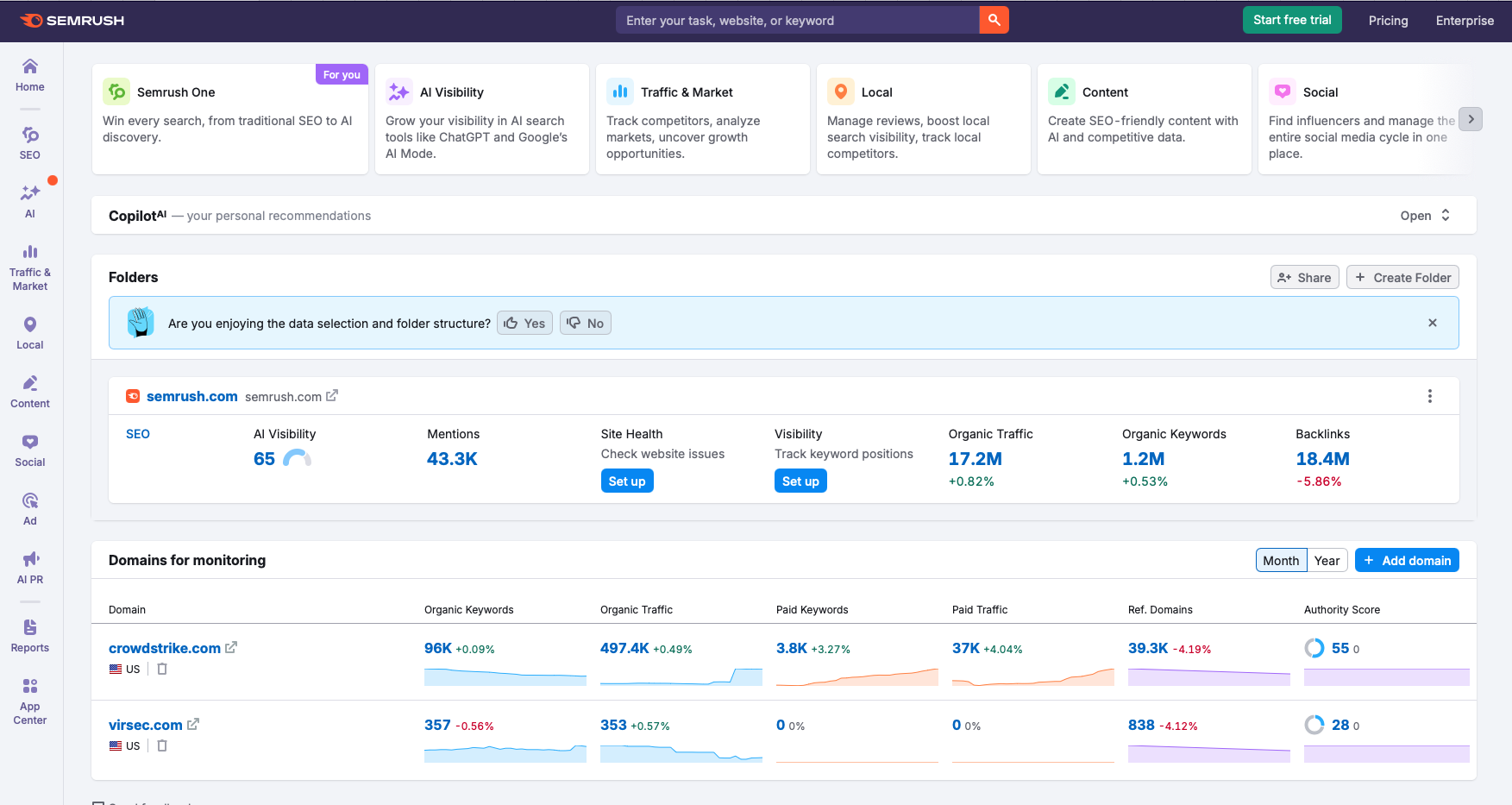
The Keyword Magic Tool doesn’t just produce keyword lists—it uses machine learning to analyze search intent, discover related themes, and automatically organize terms into semantic clusters. This makes it far easier for businesses to identify what local consumers are actually searching for and which content topics will drive meaningful traffic.
For industries like legal, healthcare, or home services, this means quickly uncovering high-value phrases that reflect real customer needs, such as “personal injury lawyer near me” or “24-hour emergency plumber.” AI-driven clustering streamlines research, eliminates guesswork, and helps teams build more focused, intent-aligned content strategies.
Each keyword is accompanied by actionable metrics such as search volume, difficulty, and competitiveness—allowing marketers to prioritize opportunities based on effort, demand, or market conditions. Question-based keywords are also surfaced, making it easier to create pages that directly answer the kinds of queries consumers pose every day.
Content Optimization & SERP Opportunity Insights
Beyond discovery, the Keyword Magic Tool helps identify which SERP features—local packs, featured snippets, FAQs, “People Also Ask” boxes—appear for each keyword. This insight guides content teams in structuring pages to win high-visibility placements and outrank competitors.
It also tracks seasonal or regional shifts in search volume. For example, a home-services company can anticipate rising demand for terms like “frozen pipe repair” during winter months and plan content or campaigns accordingly.
Advanced Local SEO & Location-Specific Targeting
One of the tool’s biggest advantages is its ability to refine keyword performance by city, state, or region across the U.S. Search behavior varies dramatically by location, and consumers often include phrases like “near me,” zip codes, or neighborhood names.
For multi-location businesses or service providers expanding into new markets, this geographic intelligence is crucial. It enables teams to build keyword strategies tailored to local intent, competition, and consumer language—ensuring each location ranks where it matters most.
Why It Matters for AI-SEO
Combined with an AI-driven SEO workflow, SEMrush’s capabilities (now strengthened under Adobe) accelerate everything from topic discovery to content production to local ranking strategy. It allows businesses to deploy more relevant pages, aligned with intent and geography, while reducing manual research time and improving the precision of their digital footprint.
3. Surfer SEO
Surfer SEO is an AI-powered on-page optimization tool designed to take the guesswork out of improving your rankings. By analyzing top-performing pages, it provides actionable, data-based recommendations to help your content climb the search results. Essentially, it compares your content to what’s already ranking and offers specific tips to boost your chances.
One standout feature is its real-time content scoring system, which evaluates your content as you write. This means you can make adjustments instantly to improve your optimization score.
Content Optimization and SERP Feature Targeting
Surfer SEO breaks down the success factors of top-ranking pages for your chosen keywords. It shows you which keywords are most frequently used, the ideal content length, and how thoroughly you need to address the topic. For businesses in sectors like legal, healthcare, or finance, this insight is invaluable. You can see what your competitors are doing well and create content that meets or exceeds that standard.
Using Natural Language Processing (NLP), the platform identifies related terms and phrases that add depth and context to your content. This isn’t just about stuffing in keywords – it’s about understanding the relationships between them. For example, if you’re writing about dental implants, terms like “osseointegration”, “titanium posts”, or “bone grafting” can help establish your expertise.
Surfer SEO also helps you target SERP features like featured snippets, knowledge panels, and local packs. For instance, a personal injury law firm might format content to answer questions like “How long do I have to file a claim?” in a way that increases the chances of appearing in a featured snippet.
The tool even generates SEO-optimized outlines and briefs, offering a clear roadmap for your content. These briefs include suggested headings, questions to address, and topics to cover based on what’s working for top-ranking pages. This structured approach ensures your content is both thorough and aligned with search engine expectations.
AI-Driven Keyword Research and Clustering
Surfer SEO’s keyword research tools help you find relevant terms and group them by intent and topic. This is especially useful for businesses offering a variety of services. For example, a law firm handling personal injury, family law, and estate planning can use Surfer SEO to identify related keywords, understand search intent, and organize content efficiently.
Instead of creating separate pages for every variation of a keyword, the tool groups related terms together. This not only enhances your topical authority but also avoids redundant content. For example, instead of having separate pages for “emergency plumber”, “24-hour plumber”, and “urgent plumbing repair”, you can create one comprehensive page that naturally targets all three.
The competitive analysis feature allows you to reverse-engineer the strategies of top-ranking competitors. A healthcare provider aiming to rank for “orthopedic surgery in Chicago” can analyze leading pages, pinpoint gaps in their own content, and develop stronger alternatives. This method is particularly effective in service industries where trust and detailed information are key.
Integration and Workflow Efficiency
Surfer SEO integrates seamlessly with tools like Google Docs and WordPress, allowing you to receive optimization guidance as you write. For WordPress users, this integration simplifies the publishing process, making it easier to create and post optimized content.
The platform also connects with Slack for team collaboration and works with other SEO tools like Semrush for deeper keyword and competitor research. These integrations make it a great fit for agencies managing multiple clients. You can easily share content briefs and articles with your team, keeping everyone aligned on SEO strategies.
Additional features include an integrated AI writer for generating SEO-optimized content and tools for auditing existing pages to identify optimization gaps. For multi-location businesses like dental practices or financial advisory firms, Surfer SEO’s ability to analyze search results for specific regions ensures your content is tailored to local audiences. This helps you address geographic differences in search intent while maintaining consistent branding across all locations.
Next, we’ll look at how Ahrefs Webmaster Tools can build on these strategies to further refine your local SEO efforts.
4. Ahrefs Webmaster Tools
Ahrefs Webmaster Tools (AWT) is a free resource designed to give you a clear view of your website’s technical health and performance. Since it doesn’t require a paid subscription, it’s accessible to service businesses of all sizes, making it easier to identify and fix technical issues that could be holding back your search rankings.
This tool works by routinely crawling your website to uncover issues that might need attention. It provides detailed reports on things like broken links or slow-loading pages. Let’s dive into how its auditing features help pinpoint and prioritize the issues that matter most for your rankings.
Technical SEO Auditing and Issue Prioritization
For service businesses, fixing technical problems can lead to better visibility in local search results and stronger engagement with potential clients. One standout feature of Ahrefs Webmaster Tools is the Site Audit, which scans your site and assigns a health score based on various technical factors. It organizes problems into categories by severity: major errors (e.g., broken internal links or duplicate content), warnings (e.g., missing alt text or slow page speeds), and minor notices. This hierarchy makes it easier to focus on the fixes that will have the greatest impact.
Common technical challenges for service businesses include redirect chains that slow down page loading, orphaned pages without internal links, and mixed content warnings when HTTPS pages load non-secure HTTP resources. For instance, a law firm might discover broken links on a case results page, which could hurt both user experience and search rankings. Fixing these issues can lead to noticeable improvements in how search engines crawl and index your site.
The tool also flags inefficiencies in your crawl budget by identifying resource-heavy pages that don’t add value. By blocking these pages using robots.txt or noindex tags, you can help search engines focus on your most important content.
Another helpful feature is the internal linking analysis, which shows how high-authority pages can pass value to key service pages, helping improve their visibility.
Content Optimization and SERP Feature Targeting
Ahrefs Webmaster Tools also includes a Content Explorer, which helps you evaluate how your pages are performing for specific keywords. You can view metrics like average keyword position, search volume, and estimated traffic to identify opportunities for improvement, especially for pages that are on the verge of ranking higher.
The tool also highlights how your pages align with SERP features. For example, if a featured snippet appears for a target keyword, you might reformat your content into a concise, clear response to increase your chances of capturing that spot.
Additionally, it tracks keyword rankings over time, so you can monitor visibility trends. If a page’s ranking drops, the Site Audit data can help uncover potential causes – like slower page speeds compared to industry benchmarks – that might be affecting performance.
For businesses targeting multiple service areas, the top pages report shows which content is driving the most organic traffic. This insight can help you decide whether to expand educational content or strategically link high-traffic pages to your core service offerings.
Beyond technical fixes, the platform provides tools to refine your local SEO efforts.
Local SEO and Geographic Targeting Capabilities
For service providers with multiple locations, Ahrefs Webmaster Tools offers valuable insights into local SEO performance. The organic keywords report highlights location-based terms your site ranks for, helping you understand your local visibility. For example, a dental practice with several locations can track how each location’s page performs for specific local searches, revealing whether improvements in local content or signals are needed.
The backlink analysis feature identifies which local directories, news sites, or community organizations link to your site. It also highlights any missing local citations that could enhance your local rankings and referral traffic.
The platform can also uncover geographic content gaps. For instance, if a law firm operates in several counties but has detailed content for only a few, the tool might show lower keyword visibility in the underserved areas. Creating location-specific pages with unique content can help capture more local searches.
Lastly, the site structure visualization offers a clear view of how location pages are linked and organized. If some pages are buried several clicks away from the homepage, simplifying your navigation could improve accessibility and rankings.
With regular updates, the tool ensures you’re always aware of your website’s health. Many service businesses find that once critical technical issues are resolved, search engines quickly respond, leading to improved rankings within just a few weeks.
5. MarketMuse
MarketMuse is an AI-powered platform designed to help businesses create effective content strategies. It stands out by analyzing your content against top-ranking pages, providing a clear picture of how to improve. For industries like legal, healthcare, home services, and finance, MarketMuse delivers practical insights to create content that connects with local audiences. This makes it a valuable tool for building strong, locally-focused SEO strategies.MarketMuse is an AI-powered platform designed to help businesses create effective content strategies. It stands out by analyzing your content against top-ranking pages, providing a clear picture of how to improve. For industries like legal, healthcare, home services, and finance, MarketMuse delivers practical insights to create content that connects with local audiences. This makes it a valuable tool for building strong, locally-focused SEO strategies.
6. BrightLocal
BrightLocal offers tools designed to enhance a business’s local search presence, making it especially useful for service industries like legal firms, healthcare providers, home services, and financial advisors. These businesses often face unique challenges when trying to appear in local search results, where potential customers are actively seeking nearby solutions. Let’s dive into how BrightLocal’s features simplify local SEO.
Local SEO and Geographic Targeting Capabilities
BrightLocal excels at helping businesses stand out in specific areas through local search optimization. One of its key features is monitoring your business listings to ensure your NAP (Name, Address, Phone number) data remains consistent. Why does this matter? Search engines rely on this consistency as a trust signal when determining which businesses to display in local search results.
The platform also includes local rank tracking, which shows your search rankings in specific areas. For example, if you run a dental practice in Austin, Texas, you can track how you rank for terms like “emergency dentist” across various ZIP codes in the city. This detailed data helps pinpoint which areas need improvement and where your marketing efforts are succeeding.
Managing your Google Business Profile is another area where BrightLocal shines. The platform notifies you of changes to your profile, tracks incoming reviews, and provides insights into how customers interact with your listing. For service-based businesses, an optimized Google Business Profile can significantly impact how many calls or direction requests you receive.
BrightLocal’s citation tracking feature ensures your business information is accurate across directories. If your phone number or business name is inconsistent across different sites, search engines may struggle to confirm your legitimacy. BrightLocal identifies these inconsistencies, helping you fix them before they hurt your local search rankings.
With its review monitoring and management tools, BrightLocal consolidates customer reviews, allowing you to respond promptly. It also analyzes review sentiment, highlighting recurring feedback themes that could indicate areas for operational improvement.
Finally, the local search audit evaluates critical elements of your SEO strategy, including your Google Business Profile, citation accuracy, and review activity. This audit provides a clear roadmap, helping you address the most pressing issues to improve your local rankings. Together, these tools create a solid foundation for sustained local SEO success.
7. DeepCrawl
DeepCrawl, now rebranded as Lumar, is a powerful platform designed to tackle technical SEO challenges for large-scale websites. It’s particularly useful for industries like healthcare systems with multiple locations or national legal firms, where managing hundreds or even thousands of web pages can be overwhelming. Lumar focuses on identifying and resolving the technical issues that can quietly harm your search rankings.
Technical SEO Auditing and Issue Prioritization
Lumar specializes in improving technical SEO health, ensuring accessibility compliance, and optimizing site speed – three critical factors for better search engine performance.
When Lumar crawls your website, it pinpoints issues like broken links, duplicate content, missing meta descriptions, and crawl errors that may block search engines from indexing your pages. For example, a healthcare organization with numerous service pages across various locations can use Lumar to address these problems and improve visibility.
What sets Lumar apart is its ability to categorize issues by severity. This prioritization helps businesses focus on the most pressing problems first, saving both time and resources – especially for those without dedicated technical teams. Once these high-priority issues are addressed, attention can shift to other areas like performance and accessibility.
The platform also identifies reasons behind slow page speeds, such as oversized images, inefficient coding, or slow server responses. By resolving these issues, Lumar ensures your site performs efficiently – an essential factor for industries where professionalism and trust are critical.
Additionally, Lumar includes accessibility features to ensure your website meets standards for users with disabilities. Enhancing accessibility not only benefits your audience but also helps search engines better understand and index your content, aligning with SEO best practices.
Embracing AI Optimization
“Lumar has launched a new GEO toolkit to enhance AI visibility for websites. This toolkit provides dashboards and reports to optimize sites for AI discovery, understanding, and inclusion. It offers insights into AI crawlability, rendering, and indexability, helping brands improve their presence in AI-generated responses and AI search features.”
For service-based industries, Lumar provides the technical foundation needed to support robust SEO strategies. While its features are best suited for larger organizations with complex website structures, businesses with extensive service offerings or multi-location operations can greatly benefit from its detailed auditing and optimization tools.
8. Clearscope

Clearscope is a content optimization platform designed to help boost search rankings by enhancing the relevance and depth of your content. Unlike tools that focus on technical SEO or backlinks, Clearscope zeroes in on making your existing content more useful and engaging for both search engines and readers. This is especially valuable for service-based industries like legal firms, healthcare providers, and financial advisors, where crafting content that answers client questions comprehensively is critical.
Content Optimization and Targeting SERP Features
Clearscope works by analyzing top-performing pages for your target keywords. It identifies the terms, concepts, and topics that consistently appear in high-ranking content. Essentially, it deciphers what search engines already value for specific queries.
When you input a target keyword, Clearscope generates a detailed semantic report highlighting essential related terms and concepts. For instance, if you’re creating content about “estate planning services”, the tool might suggest covering topics like wills, trusts, probate, beneficiaries, and asset protection – terms commonly found in top-ranking pages. This approach ensures your content is thorough and not narrowly focused on a single keyword.
The platform also provides a real-time content grade that measures how well your content stacks up against competitors. It flags missing terms, overused phrases, and even compares your content length to that of successful pages. With this feedback, writers and marketers can fine-tune their content without relying on guesswork.
Clearscope goes a step further by identifying opportunities to target SERP features like featured snippets, “People Also Ask” boxes, and related searches. Structuring your content to answer specific questions clearly and concisely can improve your chances of securing these features. For example, a healthcare provider writing about “symptoms of diabetes” might use Clearscope to format sections as direct answers to common questions, increasing the likelihood of appearing in a featured snippet.
To streamline the process, Clearscope integrates seamlessly with tools like Google Docs and WordPress, making it easier for service businesses without dedicated SEO teams to optimize their content without juggling multiple platforms.
One standout feature of Clearscope is its emphasis on user intent. The platform helps you determine whether searchers are looking for information, comparing options, or ready to take immediate action. This insight is crucial for service industries. For example, a law firm writing about “personal injury claims” can decide whether to focus on educational content or service-oriented language based on what the top-ranking pages indicate.
Clearscope doesn’t replace subject matter expertise – it enhances it. By aligning expert knowledge with search engine expectations, it helps businesses in competitive sectors create content that educates potential clients while performing well in search results.
Next, we’ll explore how Moz Pro uses AI to refine your local SEO strategy.
9. Moz Pro
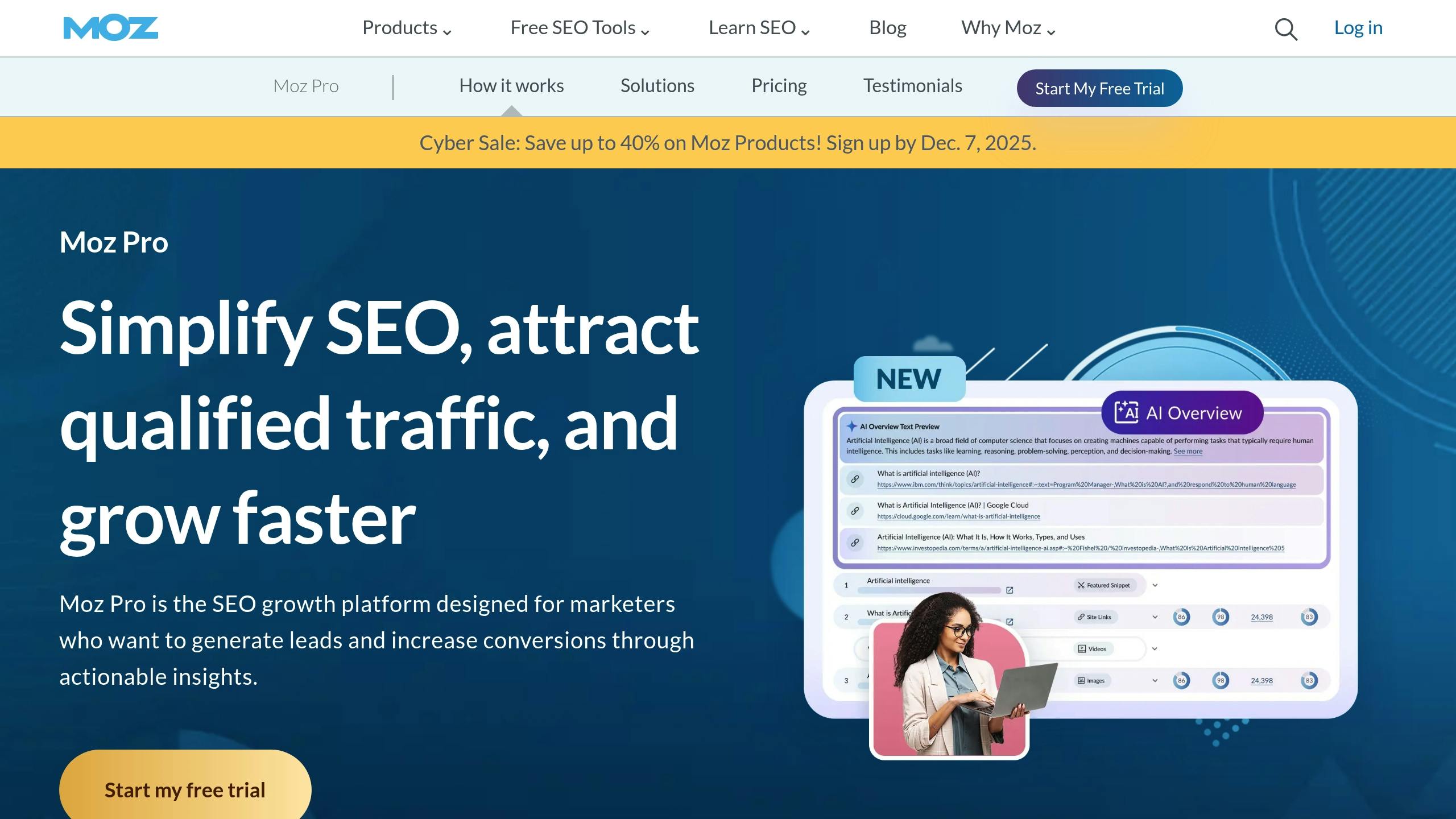
Moz Pro (2025) is another tool reshaping local SEO through the power of AI. It leverages machine learning to identify search behavior patterns that traditional methods might overlook. One standout feature is its ability to group related keywords by clustering diverse user queries. For example, a law firm might discover that searches like “car accident lawyer”, “auto injury attorney”, and “vehicle crash legal help” are grouped together. This makes it easier to craft a focused content strategy that aligns with shared user intent.
10. ChatGPT for SEO by OpenAI
ChatGPT has become a handy SEO assistant, tackling a range of optimization hurdles with its natural language processing (NLP) capabilities. It handles complex SEO questions and delivers targeted, industry-specific suggestions.
AI-powered keyword research and grouping
ChatGPT simplifies keyword research by identifying opportunities through conversational prompts. Instead of manually sorting through endless lists of keywords, you can ask ChatGPT to find connections between search terms. For example, a healthcare provider might request keyword clusters around “urgent care services.” ChatGPT would then organize related phrases like “walk-in clinic near me”, “emergency medical treatment”, and “same-day doctor appointments” into groups based on user intent.
It’s also great for discovering long-tail keywords that traditional tools might overlook. By analyzing how people naturally phrase their searches, ChatGPT identifies conversational terms that align with voice search trends. This is especially useful for businesses targeting local customers who rely on mobile devices for quick solutions. These insights naturally tie into content creation and refinement.
Content optimization and SERP feature focus
ChatGPT makes content creation more efficient by generating SEO-friendly outlines and suggesting ways to improve existing pages. Provide it with your target keywords, and it can recommend content structures that match what’s ranking well in your industry. It also evaluates search intent, helping you decide if your content should be informational, transactional, or navigational.
For optimizing SERP features, ChatGPT can help craft featured snippet-ready content by formatting concise, structured answers. For instance, financial services companies can use it to create FAQ sections answering questions like “What credit score do I need for a mortgage?” or “How long does loan approval take?” ChatGPT offers tips on ideal answer lengths and formats to increase the chances of securing position zero.
It also generates keyword-rich meta descriptions within the 155-160 character range, saving time during large-scale content updates while maintaining consistency across your site. Additionally, ChatGPT supports local SEO strategies.
Local SEO and geographic targeting
Building on its strengths in keyword and content optimization, ChatGPT helps scale local SEO by creating location-specific pages. For instance, a home services company operating in multiple cities can use ChatGPT to craft unique service area pages that avoid duplicate content. It includes local landmarks, neighborhood names, and regional terms to make each page feel personalized rather than generic.
The tool also fine-tunes Google Business Profile descriptions by suggesting summaries packed with relevant keywords that emphasize key selling points. Legal firms, for example, can ask ChatGPT to create concise descriptions highlighting their practice areas, expertise, and service locations.
For businesses with multiple locations, ChatGPT assists in generating localized blog posts tailored to specific search needs. A healthcare provider could use it to write articles about seasonal health concerns relevant to different climates or state-specific health regulations. This ensures your content connects with local audiences in a meaningful way.
What Service Industries Need to Know
Service industries face distinct challenges when it comes to SEO, and generic strategies often fall short. Businesses like legal firms, healthcare providers, home service companies, and financial advisors not only operate under strict regulations but also compete for local customers who need trustworthy and immediate solutions. This is where AI-powered SEO tools can make a difference – if tailored to the specific needs of each industry.
Compliance is non-negotiable, especially for sectors like healthcare and legal services. For instance, dental practices using AI to create service pages must ensure that before-and-after photos respect patient privacy laws, and treatment descriptions avoid making unverifiable claims. Similarly, financial advisors must ensure that AI-generated content about investment strategies includes proper disclaimers and avoids language suggesting guarantees. Every piece of AI-generated content should be reviewed by a compliance team before it goes live, ensuring it aligns with regulations like HIPAA, ADA, or state bar guidelines.
In service industries, trust is everything. AI tools can help build that trust by crafting detailed bios that highlight key certifications, memberships, and case results. This not only boosts credibility with potential clients but also improves visibility on search engines.
Local visibility is a game-changer. For example, a Phoenix-based plumbing company needs to rank for hyper-local keywords like “emergency plumber Phoenix” or “water heater repair Scottsdale.” AI tools can streamline the creation of location-specific content without falling into the trap of duplicate pages that Google penalizes. Instead of manually creating separate pages for each area, AI can generate unique content that references local landmarks, zip codes, and community-specific issues. For instance, a home services company might create pages addressing “foundation repair in older Tempe neighborhoods” or “AC maintenance for North Phoenix desert climate”, making the content genuinely helpful for local users.
Service area pages should address the specific concerns of local audiences. For example, an HVAC company in Houston might focus on issues like humidity and hurricane preparation, while one in Dallas could emphasize energy efficiency. AI tools can identify these regional differences and suggest tailored content angles to ensure relevance.
Reviews play a crucial role in rankings and conversions. AI tools can monitor reviews, flag negative feedback, and even generate personalized, compliant responses to improve a business’s reputation and local search rankings. Beyond that, reviews can inform your content strategy. For example, if multiple patients ask about recovery times for a specific procedure, you can create detailed FAQ content addressing those concerns. AI tools can scan hundreds of reviews quickly, identify recurring themes, and suggest content topics that directly address customer questions.
Mobile optimization is a must. AI-optimized content should load quickly, display clearly on smaller screens, and prioritize key information like contact details, hours, and emergency services at the top of the page. AI tools can analyze your mobile site’s speed and pinpoint issues like oversized images or poorly optimized code that might slow things down.
Voice search is also becoming increasingly important. Focus on conversational queries like “Where’s the nearest open dentist?” or “How much does a will cost in Arizona?” AI tools can help identify these question-based keywords and format concise answers that improve your chances of ranking in voice search results.
Quality over quantity matters for service businesses. Instead of churning out endless pages, use AI to enhance existing content with case studies, detailed service descriptions, and resource guides that establish local authority. For businesses with multiple locations, AI can generate unique, location-specific pages that maintain brand consistency while including local details like nearby schools, shopping centers, or demographics. This ensures each page is relevant and engaging.
Finally, leverage AI tools to implement structured data like LocalBusiness, MedicalBusiness, or ProfessionalService schema. These schemas can include details like hours, services, insurance options, and service areas, boosting your chances of appearing in rich results and increasing click-through rates. When done right, this structured approach can create a powerful AI-driven ecosystem that helps service businesses dominate local search rankings.
Timeline and Expected Results
When using AI SEO tools, it’s important to set realistic expectations for results. Many businesses begin noticing initial improvements – like better keyword targeting, enhanced content structure, and optimized technical SEO – within the first 4–6 weeks of implementation.
However, more noticeable ranking improvements often take longer. On average, significant gains in search rankings emerge after 3–4 months of consistent effort. Factors like your domain authority, local competition, and the quality of your execution play a big role in determining the pace of progress. This highlights the need for a steady, ongoing approach to SEO.
SEO isn’t a “set-it-and-forget-it” task. Search engines regularly update their algorithms, and AI tools like Perplexity, Gemini, and ChatGPT evolve their outputs with live web updates and continuous training. To stay competitive, businesses must monitor their SEO performance consistently, conduct monthly audits, and adapt to algorithm changes to build on early wins.
Regular content reviews are also essential. Identify pages that aren’t performing well and update them with fresh data to keep them relevant. Tools like Surfer SEO simplify this process by offering daily performance checks and actionable recommendations. Features like Content Audit can pinpoint problem areas, saving you the hassle of manual tracking. These insights are invaluable for creating a structured, step-by-step approach to SEO.
Conclusion
This combination of efficiency and adaptability is especially valuable in today’s fiercely competitive local markets. For service-based industries like legal, healthcare, home services, and finance, the stakes have never been higher. These businesses can leverage AI tools to boost local visibility, create highly targeted content, and allocate resources more effectively. Whether using all-in-one platforms or specialized tools, each solution plays a key role in sharpening your local SEO strategy and standing out in crowded markets.
FAQs
How can AI SEO tools help service-based businesses improve their local search rankings?
How is AI-powered SEO different from traditional SEO in 2026?
Unlike the older methods that concentrated on climbing search engine rankings, AI-driven SEO emphasizes creating content tailored to AI algorithms. This approach enhances visibility across platforms like voice searches, chatbots, and AI-powered search tools. For businesses, adapting to this change is essential to remain competitive in a digital world increasingly shaped by artificial intelligence.